

A furniture supplier may win a first order with an attractive quotation, a carefully prepared sample and fast communication. Winning the second order is harder. Repeat business depends on whether the supplier can reproduce the approved product consistently, protect it through delivery, meet the agreed schedule and resolve problems responsibly.
For importers, retailers and e-commerce brands, supplier evaluation should therefore continue after sampling. A sample proves that one unit can be made; it does not prove that hundreds or thousands of units can be produced to the same standard.
Why Samples Do Not Guarantee Consistent Mass Production
A development sample may receive additional attention from experienced workers and may include manual adjustments that are not practical during bulk production. Once an order moves to the production line, consistency depends on controlled specifications, machine settings, approved materials, trained operators and inspections.
Before mass production, buyers and suppliers should lock the golden sample, signed product specification, approved bill of materials (BOM), packaging standard and revision number. A first-article inspection should then confirm that the production line can reproduce those requirements.
1. The Quotation Was Low Because the Specification Was Incomplete

An unusually low quotation does not automatically indicate poor quality. It may reflect a different material grade, hardware specification, carton construction, inspection scope, payment term or excluded service. Problems arise when those assumptions are not written down and approved.
A meaningful quotation should identify the board or material specification, finish, hardware, packing method, order quantity, test requirements, Incoterm and validity period. Buyers should compare total landed risk—not unit price alone.
2. Product Changes and BOM Revisions Are Not Controlled
Furniture projects often change after sampling. A panel thickness may be adjusted, a hinge replaced, a finish revised or a carton reinforced. If drawings, BOMs, labels and packing instructions do not share the same revision, the factory can produce a mixture of old and new requirements.
- assign a revision number and approval date to each specification;
- record who approved every material or construction change;
- update drawings, BOM, packaging and assembly instructions together;
- retain an approved reference sample;
- prevent unapproved component substitution.
3. Production Communication Has No Reporting System
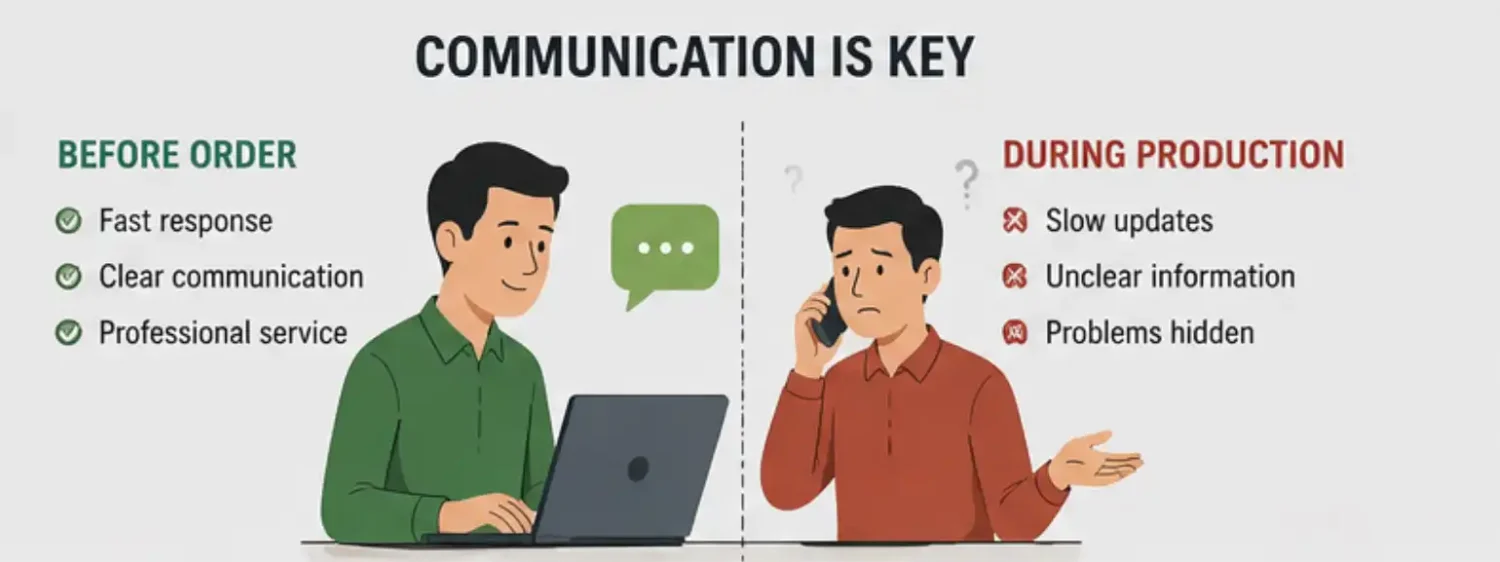
Manufacturing problems can occur even in a capable factory. Materials may arrive late, colors may vary or packaging components may fail inspection. The difference is how quickly the issue is identified, documented and escalated.
Buyers should agree on production milestones, update frequency, responsible contacts and the information required when a deviation occurs. Changes affecting quality, cost or delivery should receive written approval. When a recurring issue appears, the supplier should provide root-cause analysis and a corrective-action plan.
In international manufacturing, transparency matters more than pretending that problems never happen.
4. Packaging Is Designed Too Late
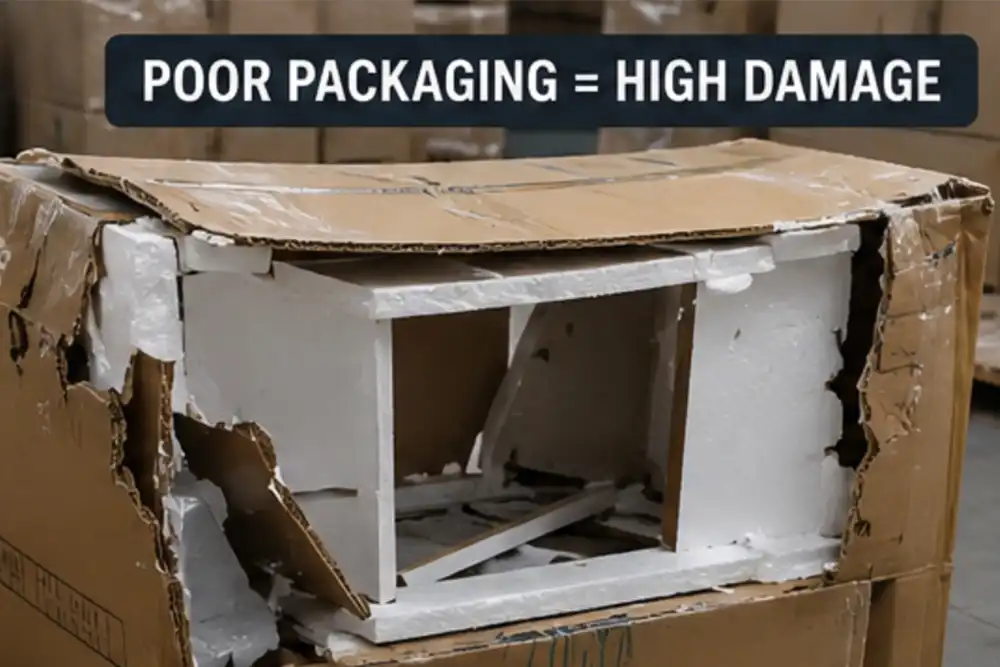
For exported and flat-pack furniture, packaging is part of the product. The carton may pass through a factory warehouse, container loading, customs handling, a distribution center, parcel networks and the customer’s home.
Before shipment, buyers should approve the complete packed sample and verify:
- carton dimensions and gross weight;
- board grade or carton-strength specification;
- corner, edge and surface protection;
- hardware location and protection from loose movement;
- part identification and assembly instructions;
- loading quantity and pallet requirements;
- the applicable drop, vibration, compression or transit test.
5. Quality Control Starts Only Before Shipment
A final inspection can identify defects, but it cannot efficiently correct an entire production batch. Effective furniture quality control begins before cutting and continues through the order.
- Incoming-material checks: confirm board, metal, finish and hardware specifications.
- First-article inspection: verify the first production unit after machine setup.
- In-process checks: monitor dimensions, drilling, edge banding, welding, finish and assembly fit.
- Packaging audit: confirm parts, hardware, labels, instructions and protection.
- Pre-shipment inspection: evaluate the completed order against the approved standard.
Buyers should ask for documented checkpoints rather than accepting a general statement that the factory “has QC.”
6. The Supplier Cannot Maintain Repeat-Order Consistency
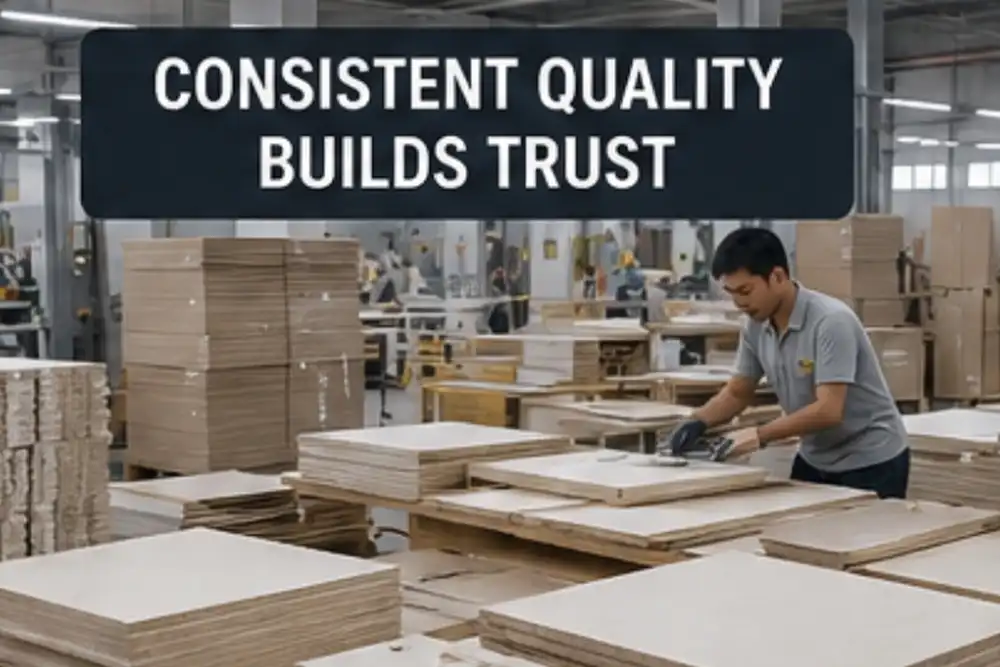
A reliable supplier must reproduce the same construction, color, hardware, packaging and documentation months later. Material availability and manufacturing conditions can change, so repeat-order control requires approved references and written substitution procedures.
Changing suppliers also creates hidden costs: new sampling, testing, packaging development, communication time, listing updates and increased quality risk. Consistency often creates more value than a small difference in purchase price.
7. Replacement Parts and Claims Are an Afterthought
Furniture can arrive with a damaged panel, missing hardware or a customer assembly issue even when the overall shipment is acceptable. Without part codes, spare components and an agreed claims process, a minor issue can become a full product return.
Before ordering, buyers should confirm spare-part availability, part identification, response times, evidence requirements and how corrective actions will be tracked for future production.
Furniture Supplier Evaluation Checklist

- Request the signed specification, BOM and revision-control method.
- Ask how the golden sample and first production unit are approved.
- Review an example of an incoming, in-process or pre-shipment QC report.
- Confirm packed dimensions, gross weight, protection and test requirements.
- Ask how substitutions and production deviations receive approval.
- Define update frequency and the escalation contact for delays or defects.
- Confirm spare-parts identification and the claims-handling process.
- Verify MOQ, sample lead time, production lead time and capacity assumptions.
- Check relevant material, safety, labeling and market-compliance requirements.
How HOMVND Prepares for Repeat Orders

HOMVND supports OEM and private-label furniture programs through product-development review, sampling, packaging coordination, quality-control checkpoints and export support. The objective is not only to make an approved sample, but to establish a specification that can be repeated in bulk and in later orders.
You can also review our private-label furniture process and supplier quality-control guide.
If you are evaluating a new furniture supplier, send us your product specification, target price, estimated quantity, sales channel and delivery market. We can review manufacturing feasibility, MOQ, packaging requirements and recommended quality-control checkpoints before sampling.
Request a pre-order feasibility review for your next furniture program.