
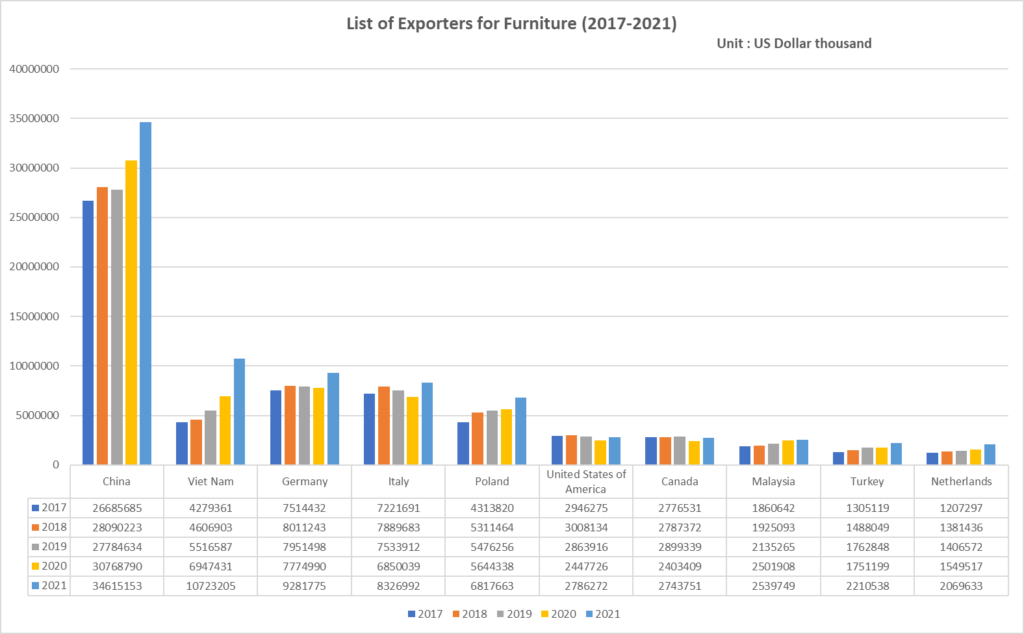
Currently, China and Vietnam lead the global furniture export market. While China maintains the highest total export volume and the widest range of furniture items, Vietnam is showing a continuous upward trend, narrowing the gap.
For businesses looking for a reliable home furniture manufacturer, choosing the right production base is crucial. Whether you prioritize low-cost furniture or a supplier with superior quality and stable supply capacity, understanding the nuances of these two manufacturing giants is key. In this article, we compare China and Vietnam across raw materials, costs, tariffs, and industrial stability.
1. Supply Chain and Raw Materials
Vietnam: Southeast Asia is rich in forest resources, meaning Vietnam has access to cheaper wood with fewer logging restrictions. However, Vietnam’s supply chain is still developing. Notably, Vietnam runs a significant trade deficit with China because it relies on importing many parts and raw materials from China to produce furniture for export. This dependency can increase manufacturing costs and complexity.
China: China boasts a mature and comprehensive industrial system. With vast area and well-developed industry, China has unparalleled advantages in manufacturing. Although facing rising raw material costs and strict import controls, China has heavily invested in materials like wood and metal to balance the supply chain.
2. Labor and Land Costs
Land Costs: Interestingly, industrial land prices in Vietnam’s Ho Chi Minh City have surged to $200 per square meter, surpassing Guangdong’s $170 per square meter. China’s vast land resources and government support for manufacturing have helped maintain a competitive edge in land costs, an area where Vietnam is gradually losing its advantage.
Labor Costs: China’s labor costs are higher than Vietnam’s. For instance, salaries in Vietnam’s industrial zones (e.g., Ho Chi Minh City) have risen to around 3,000 RMB/month, yet remain cheaper than China’s Guangdong and Fujian provinces.
3. Tariff Advantages and Trade Policies
Vietnam’s FTA Network: Vietnam has capitalized on this by leveraging Free Trade Agreements (FTAs) like the EU-Vietnam Free Trade Agreement (EVFTA) and the Regional Comprehensive Economic Partnership (RCEP). These agreements provide Vietnam with significant tariff advantages when exporting to the US and European markets, making it an attractive hub for companies looking to bypass tariffs.
The US-China Trade War: The US has imposed tariffs of up to 25% on Chinese furniture. This has driven up costs for Chinese manufacturers and led to some production shifting to Vietnam.
Conclusion: Which Should You Choose?
Both countries offer distinct advantages to the global furniture market.
If your primary goal is to have lower-cost furniture and you are willing to manage supply chain complexities, a Vietnam factory might be suitable. However, if you are looking for a furniture supplier that offers better quality control, a more stable supply capacity, and a mature industrial system, a China factory is likely the better fit.
As a professional furniture wholesale partner, HOMVND understands these dynamics deeply. Whether you need high-volume production or custom OEM/ODM solutions, we help you navigate these choices to find the best manufacturing strategy for your business.